An environmental library of Japanese picture books for children published after 1945. Books whose heroes are anthropomorphized landscapes, plants, natural objects, insects, and other more-than-human actors aim to explore how ehon convey a relationship to nature and the living world. With the hope that when a mountain has a face, it is not so easy to start digging into it.
Told from the perspective of an insect, the book introduces children to the remarkable life cycle of the cicada. It spends most of its life as a larva deep underground, then spends ten days singing its shrill song to attract its mate. (Actually, it should be said more like “crying”; in Japanese, the verb used for the chirping of insects is “naku,” to cry.)
Told from the perspective of an insect, the book introduces children to the remarkable life cycle of the cicada. It spends most of its life as a larva deep underground, then spends ten days singing its shrill song to attract its mate. (Actually, it should be said more like “crying”; in Japanese, the verb used for the chirping of insects is “naku,” to cry.)
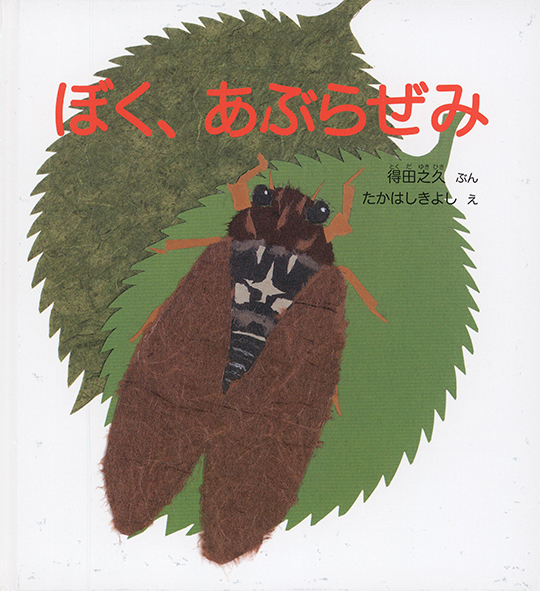
I, the Cicada Tokuda Yukihisa - text, Takahashi Kiyoshi - illustrations
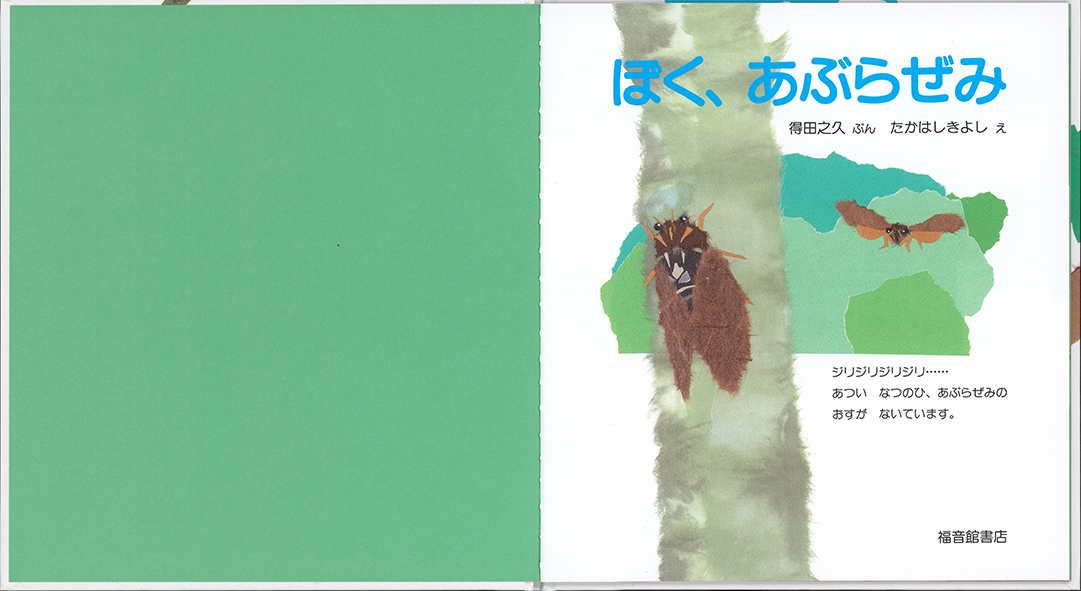
Jirijirijirijiri…… A hot summer day, a male cicada sings.
Told from the perspective of an insect, the book introduces children to the remarkable life cycle of the cicada. It spends most of its life as a larva deep underground, then spends ten days singing its shrill song to attract its mate. (Actually, it should be said more like “crying”; in Japanese, the verb used for the chirping of insects is “naku,” to cry.)
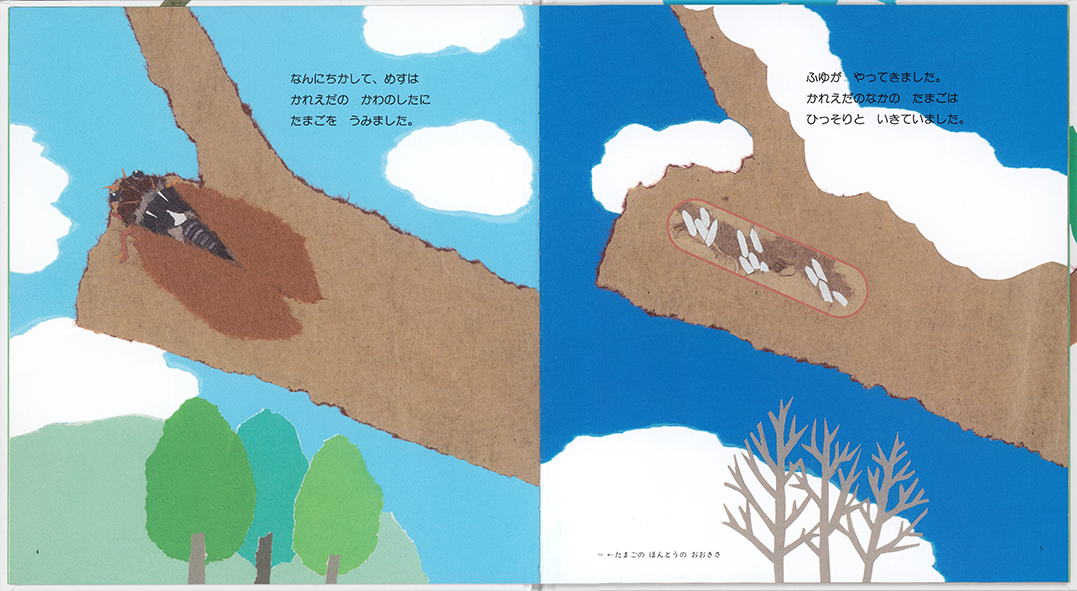
A few days later, the female lays her eggs under the wavy bark.
Winter has come. The eggs live quietly inside the dry bark.
Told from the perspective of an insect, the book introduces children to the remarkable life cycle of the cicada. It spends most of its life as a larva deep underground, then spends ten days singing its shrill song to attract its mate. (Actually, it should be said more like “crying”; in Japanese, the verb used for the chirping of insects is “naku,” to cry.)
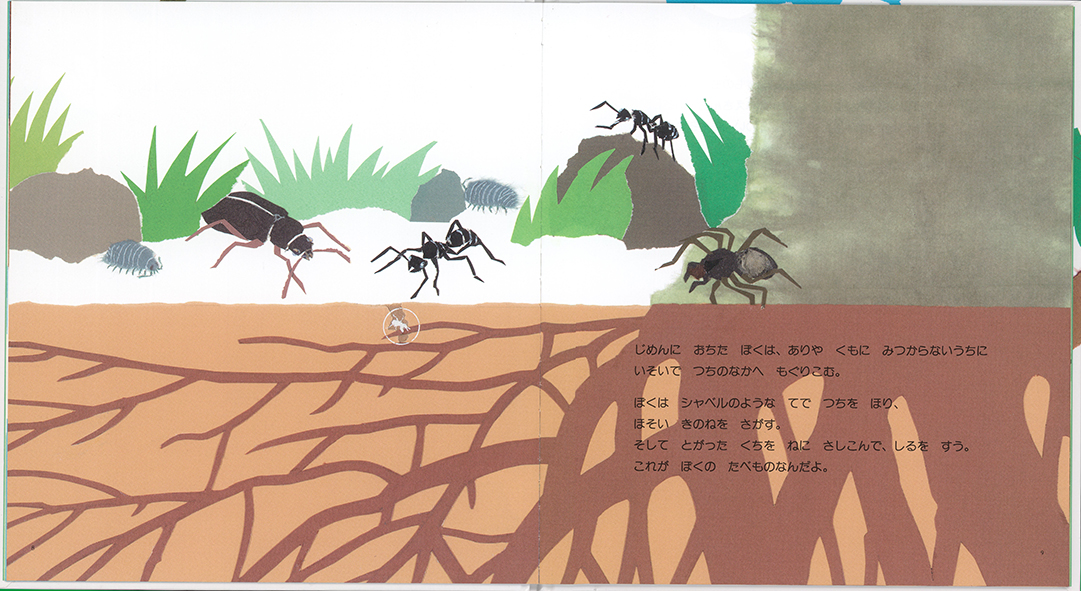
When I fall to the ground, I quickly burrow into the soil so that ants and spiders won't find me.
With my shovel-like front legs I dig my way through the dirt and look for thin tree roots.
When I find one, I bite into it and suck the juice out of it.
Told from the perspective of an insect, the book introduces children to the remarkable life cycle of the cicada. It spends most of its life as a larva deep underground, then spends ten days singing its shrill song to attract its mate. (Actually, it should be said more like “crying”; in Japanese, the verb used for the chirping of insects is “naku,” to cry.)
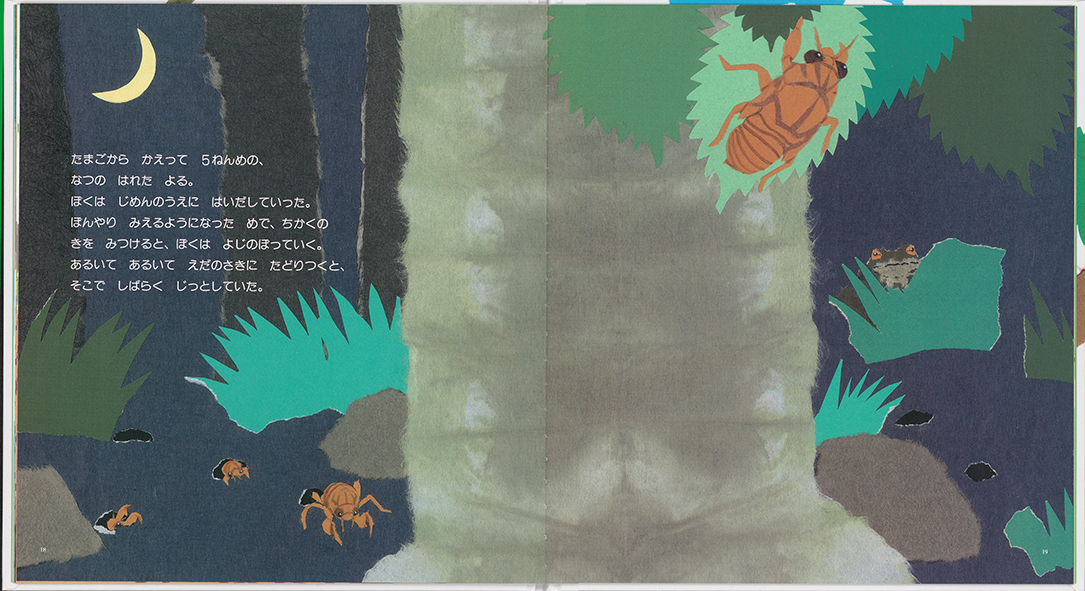
Five years have passed since then. One sunny summer night I climbed out of the ground.
When I began to see a little, I found a tree and slowly climbed up it.
I walked and walked, and when I reached a branch, I stopped there for a moment and rested.
Told from the perspective of an insect, the book introduces children to the remarkable life cycle of the cicada. It spends most of its life as a larva deep underground, then spends ten days singing its shrill song to attract its mate. (Actually, it should be said more like “crying”; in Japanese, the verb used for the chirping of insects is “naku,” to cry.)
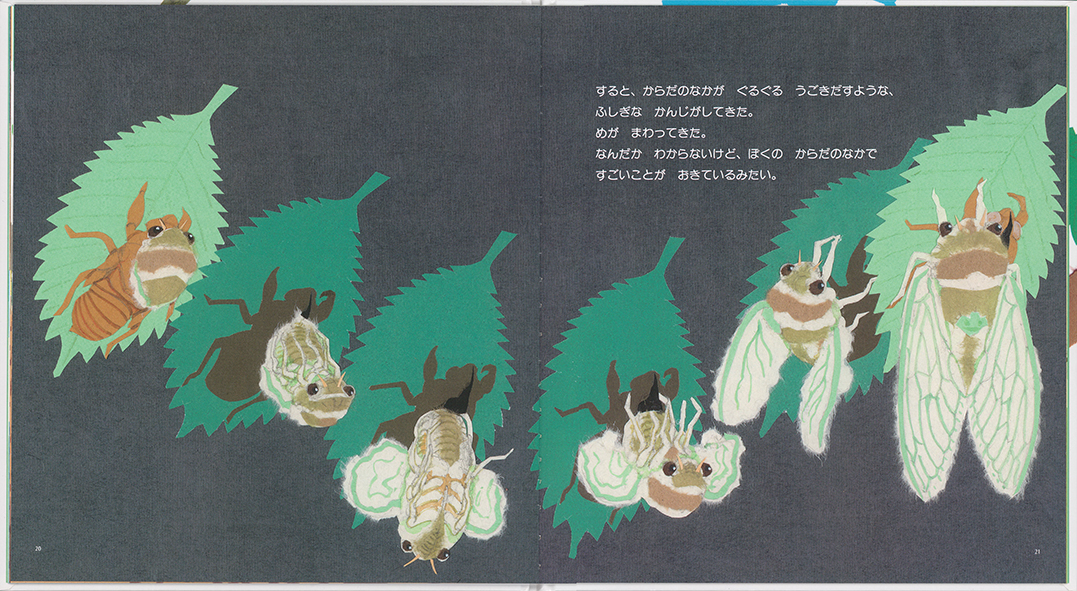
Then I started to feel something strangely twisting and moving inside my body.
My head was spinning.
I don't know why, but it seemed something big was happening inside my body.
Told from the perspective of an insect, the book introduces children to the remarkable life cycle of the cicada. It spends most of its life as a larva deep underground, then spends ten days singing its shrill song to attract its mate. (Actually, it should be said more like “crying”; in Japanese, the verb used for the chirping of insects is “naku,” to cry.)
Told from the perspective of an insect, the book introduces children to the remarkable life cycle of the cicada. It spends most of its life as a larva deep underground, then spends ten days singing its shrill song to attract its mate. (Actually, it should be said more like “crying”; in Japanese, the verb used for the chirping of insects is “naku,” to cry.)
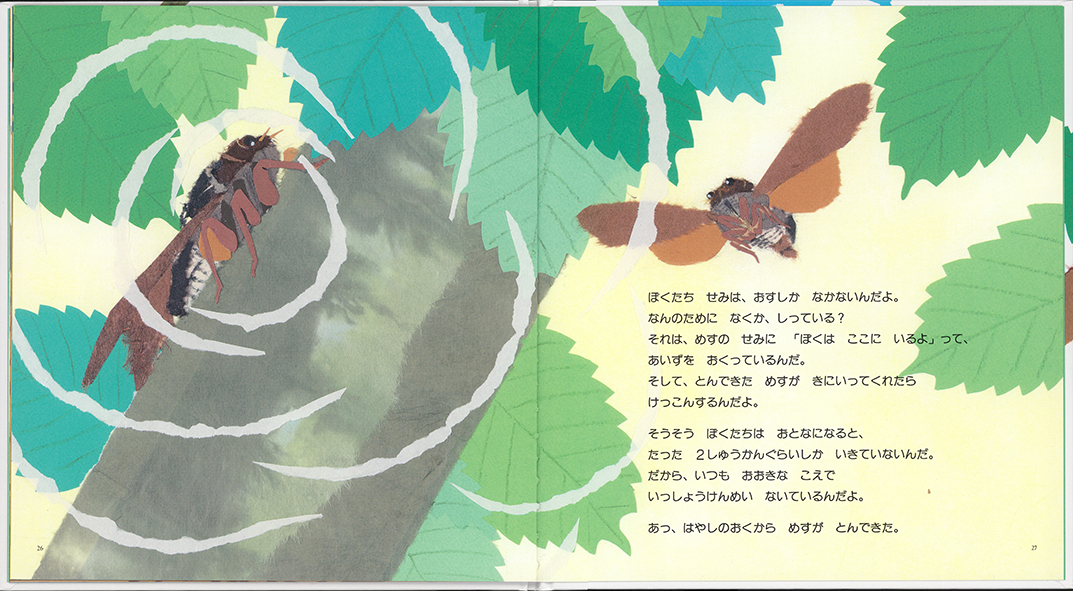
We cicadas don't fly much.
Do you know why we sing?
When we sing, we tell other cicadas: "I'm here!"
and let them know about us.
And when a female hears and likes our voice, she will come to us.
Yes, when we grow up, we only live for about a week or two.